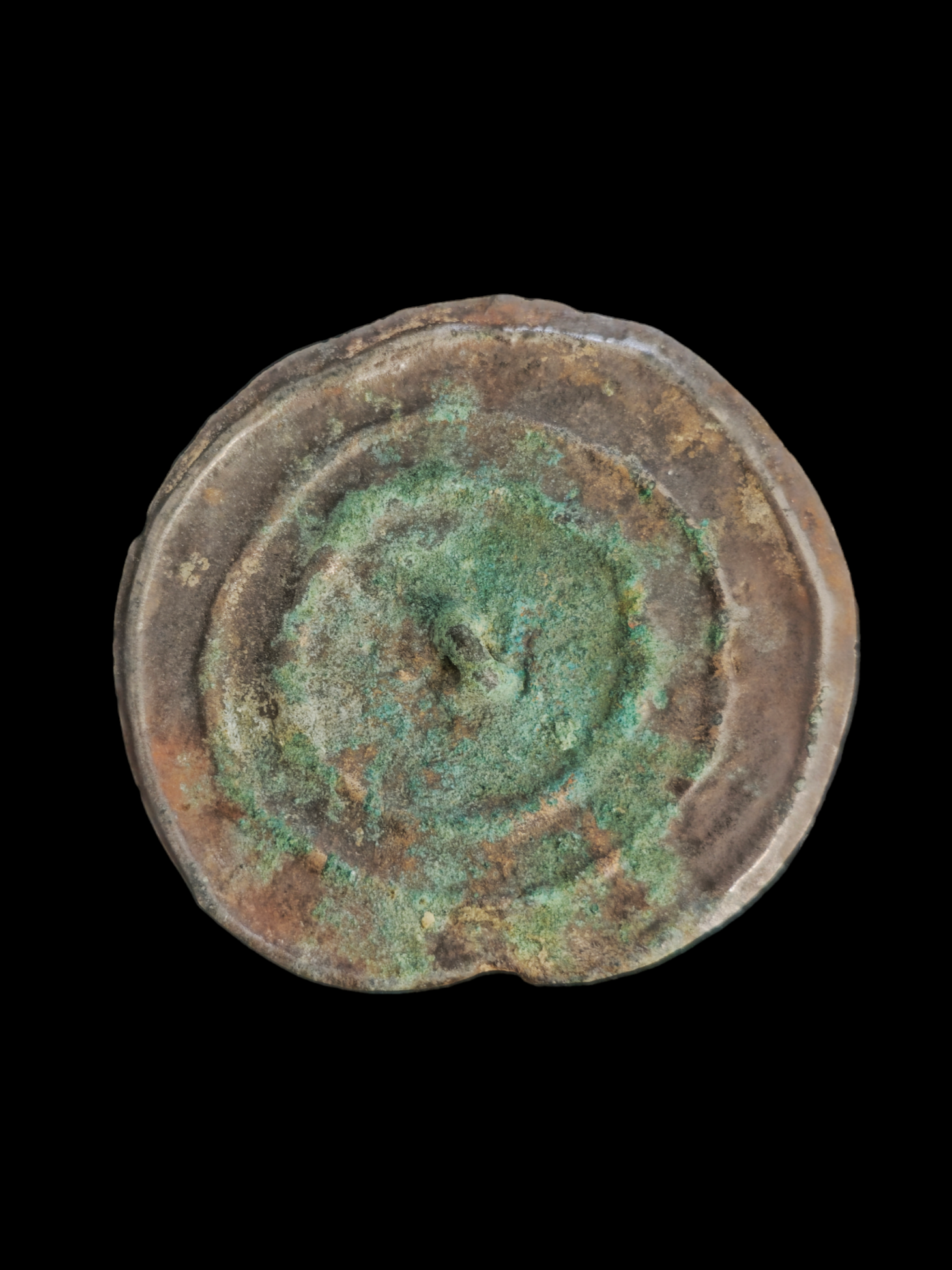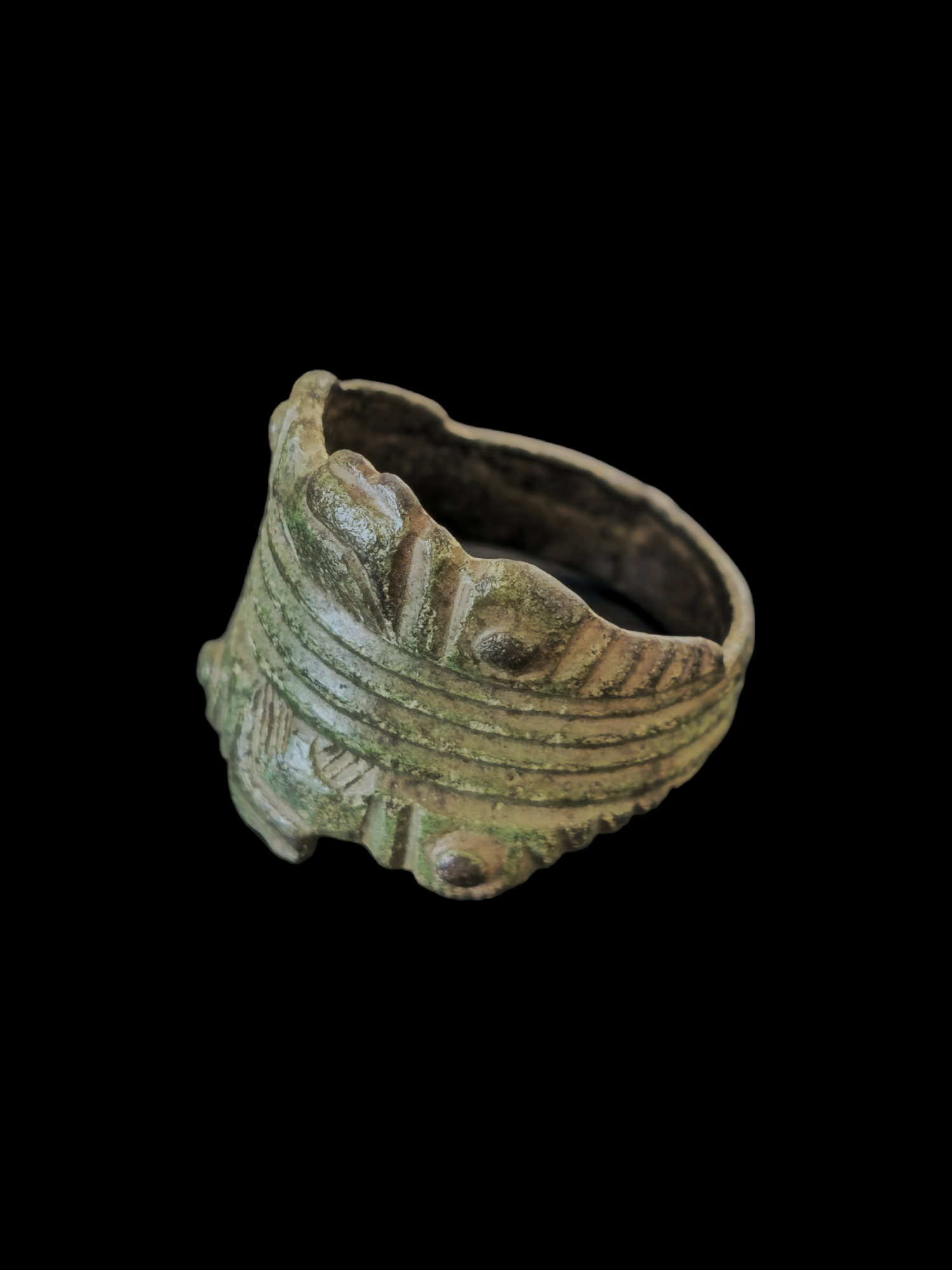

For a people who left no written language, the Scythians were astonishingly articulate. From the seventh century BCE onward, the nomadic horsemen of the Eurasian steppe poured their imagination into metal — and what they made was almost always an animal. A stag curled into a disc, its antlers swept back along its spine. An eagle stooping over a hare. A panther frozen in the act of turning its head. The Scythian visual world is one of perpetual predation, rendered with a formal economy so assured that individual pieces can arrest the eye across two and a half millennia. Their successors, the Sarmatians, were heirs to this tradition — yet they remade it in terms so distinctly their own that the trained eye separates them almost at once. Understanding how to read these two steppe hands is among the more rewarding exercises available to anyone who collects ancient metalwork.
The Scythian Animal Style
The Scythians dominated the Pontic steppe — the grasslands north of the Black Sea, stretching from the Danube to the Don — from roughly the seventh to the third century BCE. Their art, which we encounter primarily through burial goods recovered from the great kurgans of Ukraine and the northern Caucasus, is characterised by what scholars have long called the Animal Style: a repertoire of creatures — stag, horse, eagle, feline — rendered in stylised, often interlocked form, deployed across weapons, harness fittings, garment plaques, and vessel ornament.
Several formal signatures distinguish Scythian work from later steppe production. The silhouette is primary: Scythian objects tend to work in profile, the animal’s body forming a compact, self-contained shape whose outline does much of the expressive work. Detail is incised or chased rather than built up through inlay — the surface plays with light through shallow relief rather than through the contrast of materials. The compositions are generally bilateral or radially symmetrical, and they favour the tightly wound contortion — the deer whose hooves touch its muzzle, the predator whose body curls in on itself — that creates a formal tension without compromising legibility.
The Kul-Oba kurgan near Kerch, excavated in the nineteenth century, remains one of the most spectacular single demonstrations of Scythian goldwork, its vessel ornament and personal jewellery displaying the full range of the tradition at its peak. Similarly, the Pazyryk kurgans in the Altai, though associated with a related but geographically distinct culture, share enough of the formal vocabulary to illuminate the broader steppe aesthetic across vast distances.
The Sarmatian Transformation
From approximately the third century BCE, Sarmatian peoples — successors and partly contemporaries of the Scythians, dominant across the steppe into the fourth century CE — introduced a set of changes that amounted to a thoroughgoing reimagining of the tradition they had inherited. The shift is visible across multiple dimensions simultaneously, and it is this multidimensionality that makes it so distinctive.
Where Scythian work is monochrome — exploiting the colour and lustre of gold or bronze alone — Sarmatian metalwork is polychrome. Turquoise, carnelian, and above all garnet are inlaid into gold cells to create compositions in which colour and material contrast drive the visual effect as much as line or form. This cloisonné technique, which the Sarmatians developed with considerable sophistication, would ultimately pass westward through the Migration Period into the jewellery of the Goths, the Franks, and early Anglo-Saxon England — one of the most consequential aesthetic transmissions in the history of decorative art.
“The Sarmatian cloisonné technique would ultimately pass westward through the Migration Period into the jewellery of the Goths, the Franks, and early Anglo-Saxon England — one of the most consequential aesthetic transmissions in the history of decorative art.”
Reading the Animal Combat Differently
The Sarmatian animal — particularly as it appears in the combat scenes that remain central to steppe iconography — is a different creature from its Scythian predecessor in compositional terms as well. Sarmatian compositions are frequently more dynamic and spatially complex: bodies interpenetrate, limbs extend and overlap rather than folding inward, and the overall effect is of violent outward energy rather than the compact internal tension of Scythian design. The abstraction also increases — Sarmatian animal ornament can reduce the creature to something approaching a geometric pattern, the head and hindquarters rotating into near-heraldic symmetry.
There is also a shift in the objects themselves. Sarmatian high-status burial goods include elaborate torques, phalera (round harness bosses of considerable diameter), and sword scabbard fittings whose decorative programmes incorporate both the inherited animal vocabulary and new geometric and vegetal elements absorbed from contact with Iranian, Hellenistic, and eventually Roman craft traditions. The Sarmatians were, like all steppe cultures, engaged in constant cultural exchange with their sedentary neighbours, and their metalwork records those conversations.
How the Collector Distinguishes Them
In practice, the collector approaching an unlabelled piece of steppe metalwork should begin with date and geography, since these provide the primary frame: Scythian material belongs, broadly, to the first half of the first millennium BCE, while Sarmatian work runs from the later pre-Christian centuries into the early centuries CE. Object type and assemblage context — where that information survives — will often resolve the question at once.
Where the question remains open, formal analysis becomes the instrument. Monochrome gold or bronze with incised or chased Animal Style ornament, compact silhouettes, and bilateral composition speaks Scythian. Polychrome inlay, garnet or turquoise cloisonné, dynamic open compositions with interpenetrating figures, and increased abstraction in the treatment of animal forms speak Sarmatian. Pieces that combine both sets of characteristics — as some transitional works genuinely do — are historically among the most interesting, representing the period of overlap and exchange in which one aesthetic tradition was absorbing and transforming the other.
We would add one further caution, offered in the spirit of honest counsel: the steppe gold market has attracted ambitious forgeries for well over a century, and pieces without documented archaeological context require careful scrutiny. Technical analysis of alloy composition, tool marks, and surface mineralogy has become increasingly accessible and is, for significant acquisitions, a reasonable investment. The genuine article, however — the actual gold of a Scythian garment plaque or a Sarmatian phalera — remains one of the most electrifying things that the ancient world has left us. It repays the care one brings to it.