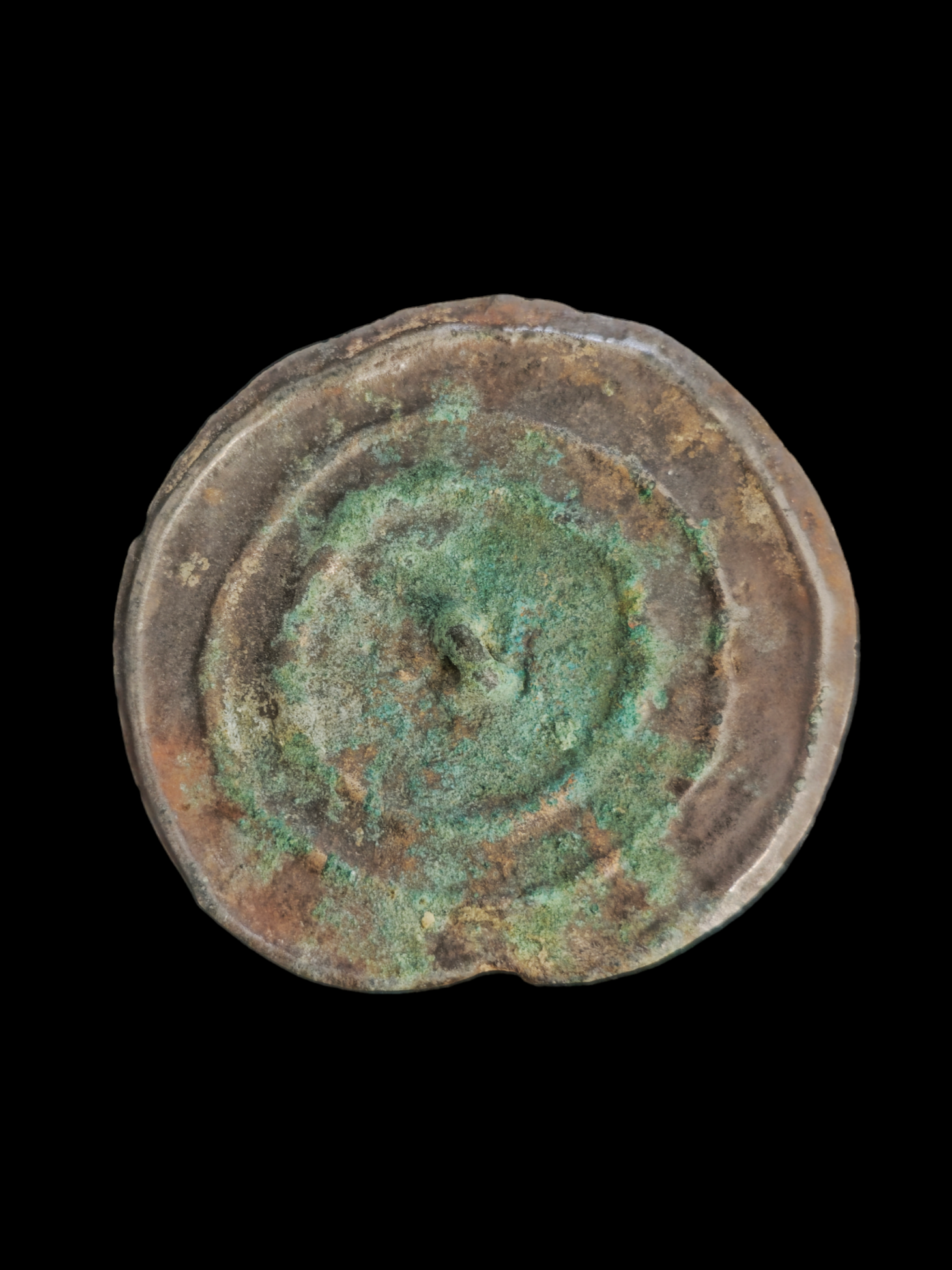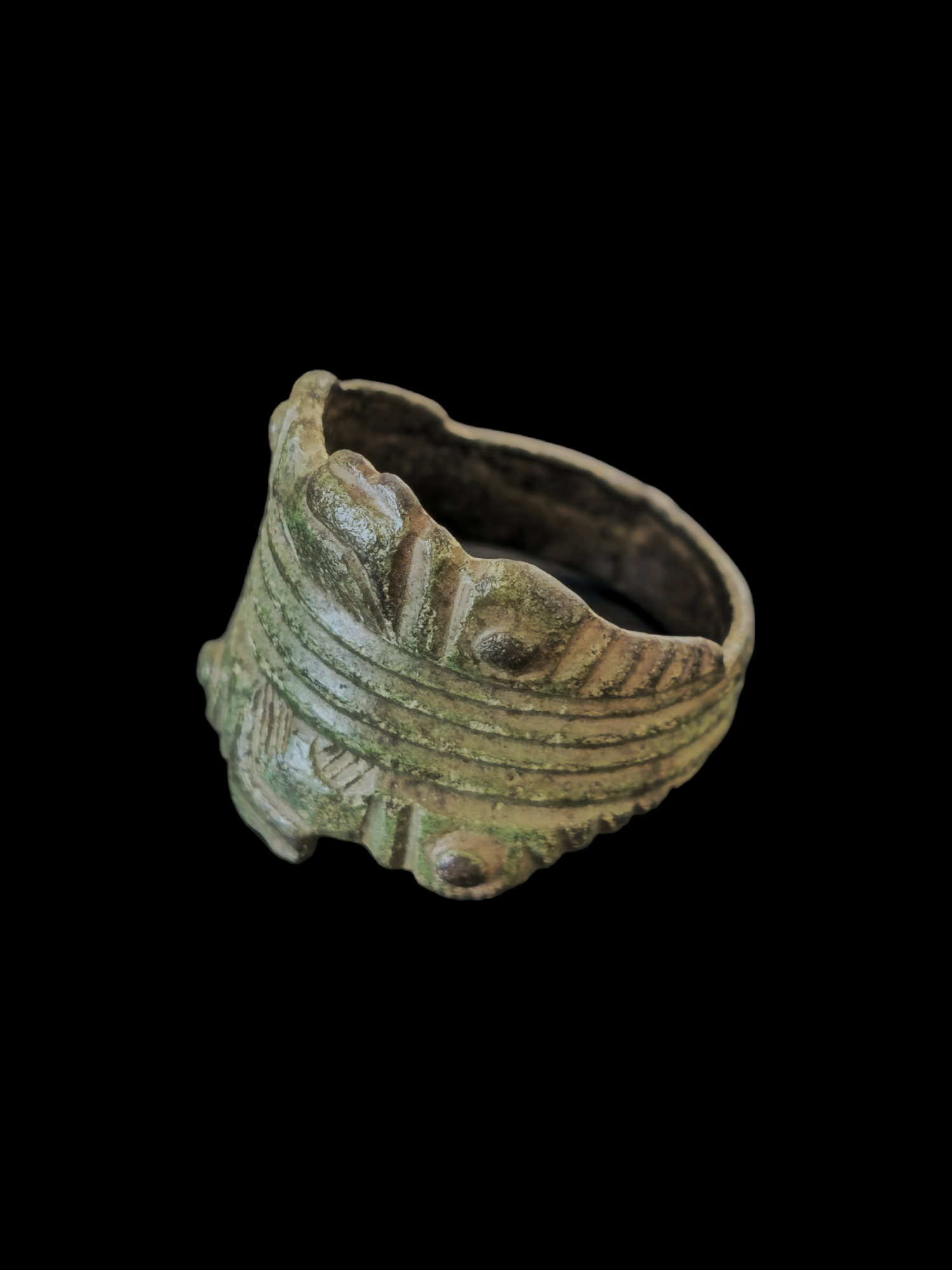

For a people who left no written language, the Scythians were astonishingly articulate. From the seventh century BCE onward, the nomadic horsemen of the Eurasian steppe poured their imagination into metal — gold, bronze, electrum — and what they made was almost always an animal. A crouching panther. A stag with its legs folded beneath it. An eagle’s head curling back upon itself. This is the Animal Style, and to hold a piece of it is to hold one half of a conversation whose other half we must reconstruct.
A grammar of beasts
The Animal Style is not decoration in the way a Greek meander is decoration. Each creature is chosen, and each is rendered according to rules. Predators — the panther, the wolf, the griffin — dominate, often caught in the moment of attack. Prey animals — the stag, the ibex, the horse — appear at rest or in the strange “flying gallop,” legs extended fore and aft. The bodies are compressed, folded, and curled to fit the object they ornament: a belt plaque, a scabbard, a horse’s cheekpiece.
A crouching panther is never simply a panther; it is power, vigilance, and the speed of the hunt, compressed into gold.
Why predators?
The steppe was a world of predation, and the Scythian elite understood themselves through it. To wear a panther at your hip or a griffin on your shield was to claim its qualities — ferocity, swiftness, the unblinking patience of the hunter. Greek writers who met the Scythians described a warrior aristocracy for whom the hunt and the raid were continuous; their art makes the same argument in gold. The recurring motif of one animal devouring another — a griffin sinking its beak into a horse, a wolf pulling down a stag — is not cruelty for its own sake. It is a statement about the order of the world, and about who, in that order, holds the advantage.
The art of compression
What distinguishes the finest Scythian work is its economy. A master could suggest an entire stag with a few swelling planes — the haunch, the shoulder, the great branching antler reduced to a rhythmic series of hooks. There is no wasted line. The animal is abstracted until it becomes pure energy, yet it never loses its species. You always know what you are looking at, even when the form has been bent almost into ornament.
This compression was partly practical. These were objects made to be worn and used on horseback, by a people who carried their wealth on their bodies. But it was also an aesthetic choice, and a remarkably consistent one, held across a vast territory from the Black Sea to the Altai for the better part of a thousand years.
Reading a piece today
When we handle a piece of steppe metalwork, we read it on several levels at once. The motif speaks of status and belief. The technique — cast, hammered, chased, sometimes inlaid — speaks of the workshop. The wear speaks of the life the object lived: the rubbing of a plaque against cloth, the polish of a mirror handled across generations. None of it is written down. All of it is legible, if you know the grammar.
That is the pleasure, and the discipline, of collecting in this field. The Scythians did not explain themselves. They expected the objects to do it for them — and, two and a half thousand years later, they still do.