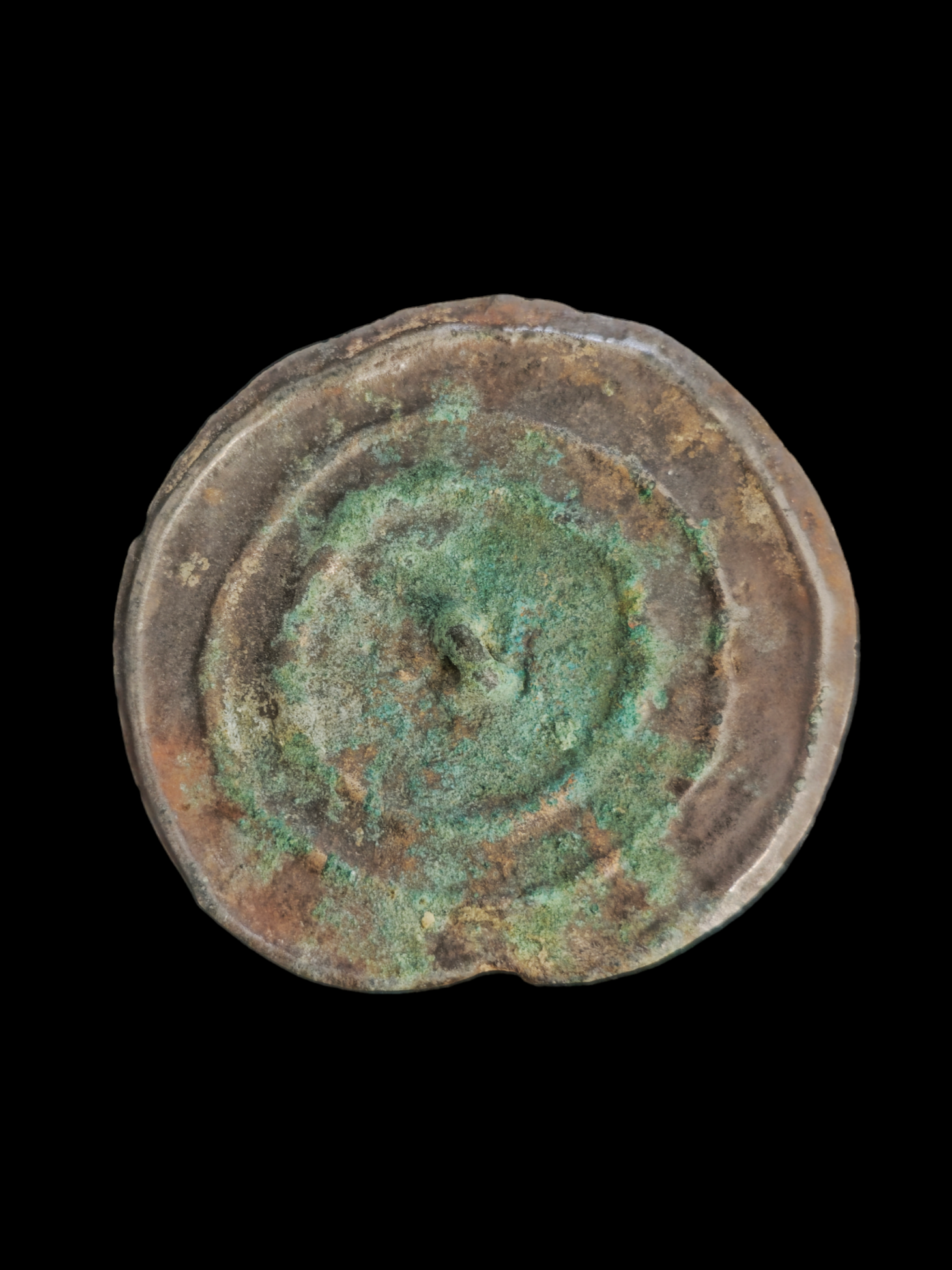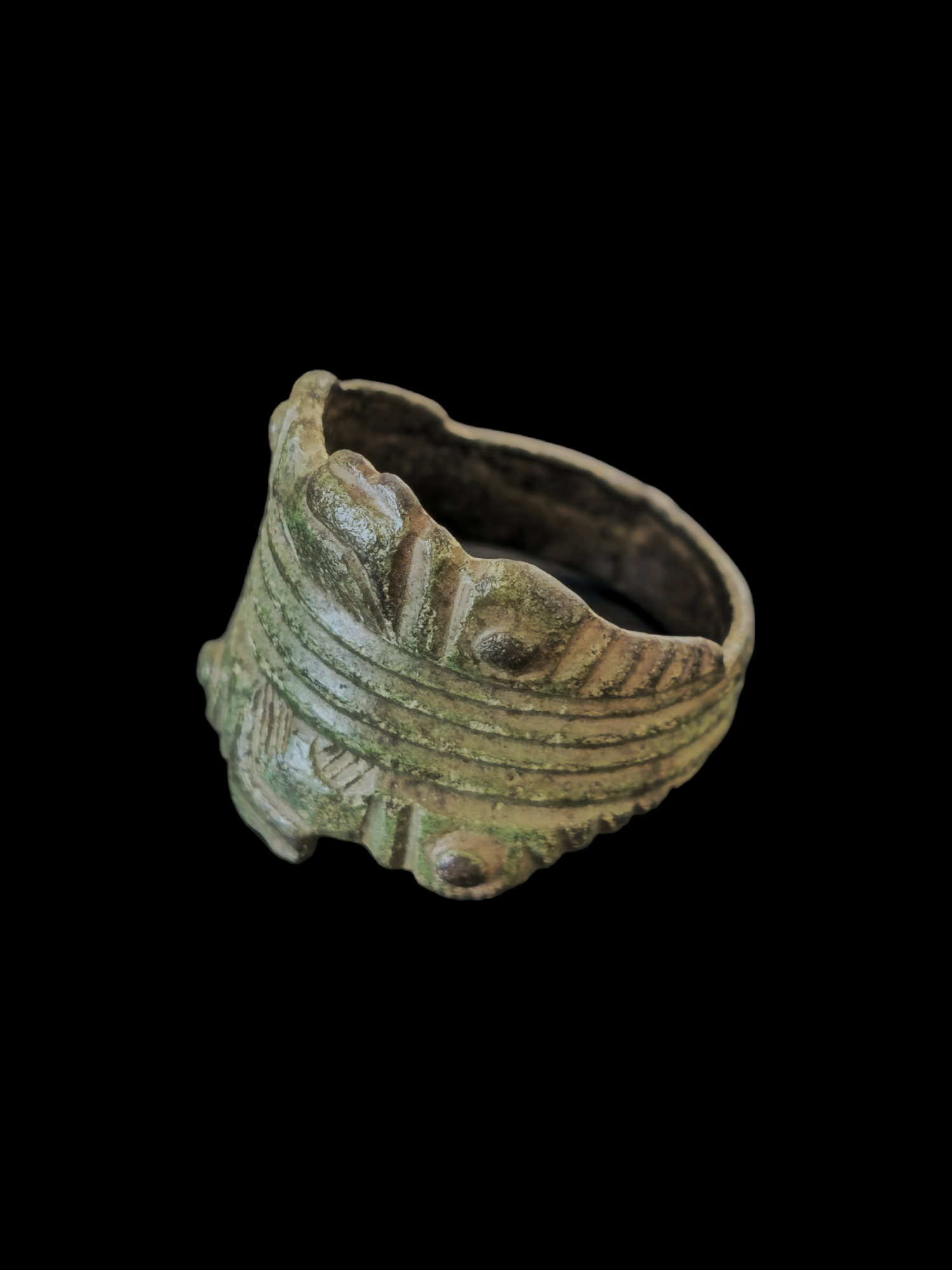

There is a particular pleasure in holding a medieval bronze buckle — one worn smooth at the tongue by decades of daily use, its surface darkened to the colour of old timber — and understanding that the hand which last fastened it belonged to a world as vivid and as mortal as our own. Cast bronze is a great democratiser of memory. It survives where cloth rots, where wood crumbles, where iron flakes to nothing. And because it was affordable in the Middle Ages, it was made in enormous quantity, carried by almost everyone, and deposited — by accident, by ritual, by the simple entropy of loss — in the ground that gives it back to us now.
Why Bronze Endures
The chemistry of copper alloy is its own form of archival intelligence. Bronze and latten, the leaded brasses favoured by medieval craftsmen, form a stable oxide layer that protects the metal beneath while recording in its texture the precise conditions of burial — the acidity of the soil, the presence of organic material, the fluctuations of moisture over centuries. What we call patina is not merely surface colouration but a mineralogical history. A deep, even malachite-green crust on a well-cast twelfth-century mount speaks differently from the warty, unstable cuprite of a piece disturbed and redeposited; the collector who learns to read these surfaces gains an instrument of authentication that no catalogue can fully replace.
Medieval bronze was cast by the lost-wax and sand-casting methods, the latter becoming increasingly dominant from the high medieval period as production volumes grew. The quality of casting varies considerably — great urban workshops with access to fine alloys and skilled labour produced very different objects from rural foundries supplying a local agricultural market — and this variation is itself historically informative. A well-finished seigneurial harness pendant with gilded details and heraldic motifs tells us something quite different about its original owner than a simple circular buckle with a plain iron pin.
The Grammar of Everyday Objects
We think often about the range of object types that survive from the medieval centuries, because their diversity is itself a kind of argument. Consider even a partial inventory:
- Dress accessories — annular brooches, penannular pins, hooked clasps, and the elaborate disc brooches of the high medieval period
- Personal adornment — finger rings (plain, inscribed, and set with paste or stone), ear-rings, and chain fittings
- Harness and horse furniture — strap distributors, pendant mounts, spur rowels, and the ornate bridle bosses that announced a rider’s status at a distance
- Devotional objects — pilgrim badges, small crucifix pendants, reliquary mounts, and the belt fittings stamped with sacred monograms
- Domestic fittings — key handles, padlock plates, vessel feet, and the decorative studs that once held leather goods together
Each category has its own typological history, its characteristic forms evolving across regions and centuries in ways that scholarship has spent generations mapping. That mapping is now sufficiently advanced that a well-documented bronze object can, in many cases, be attributed to a rough date, a probable region of manufacture, and an approximate social context with reasonable confidence.
“Cast bronze is a great democratiser of memory — it survives where cloth rots, where wood crumbles, where iron flakes to nothing.”
Devotion in Small Objects
Among medieval bronzes, the devotional category rewards particular attention. Pilgrim badges — those stamped lead-alloy or bronze souvenirs sold at shrines from Canterbury to Compostela — were made in their millions, yet they carry an intensity of meaning disproportionate to their modest material. They were touched to relics. They were sewn onto hats and cloaks as marks of spiritual achievement and social identity. They were sometimes placed in graves, accompanying the dead on a final journey that was conceived as the ultimate pilgrimage. The iconography of these objects — the scallop shell of Saint James, the ampulla of Becket’s blood, the vernicle of Rome — encodes an entire system of late medieval piety in forms small enough to fit in the palm of a hand.
Crucifix pendants and small devotional mounts occupy a similar space. They were personal, carried on the body, handled constantly. The wear patterns on surviving examples are often eloquent: a thumb-worn reverse, a loop abraded by years of suspension on a cord or chain. These are not museum objects by nature; they were made for contact, for use, for the intimate daily negotiation between a believer and the sacred.
An Entry to Collecting
We regard medieval bronze as one of the most rewarding entry points available to the new collector, for reasons that go beyond mere affordability. The typological literature is extensive and accessible — decades of work by scholars attached to national museums and field archaeology units have produced detailed type sequences for most major categories. A collector willing to spend a few hours with the standard references can quickly develop genuine competence in reading what they hold, and that competence is its own satisfaction.
The objects themselves are also forgiving teachers. Unlike gold or high-status silver, where fakes command serious investment, the modest cast bronze does not typically reward sophisticated forgery — the economics do not support it. Patina, casting quality, wear patterns, and typological consistency remain the collector’s primary instruments, and they are instruments that reward sustained, patient looking rather than specialist scientific access.
What draws us, finally, to medieval bronze is the density of life it contains. These are not luxury objects made for the archive; they are things that were used until they were lost, worn until they broke, handled by people who did not suppose anyone would ever look at them again. That unselfconsciousness is a kind of truth. The medieval past reaches us in gold and ivory, certainly — but it reaches us most honestly in bronze.