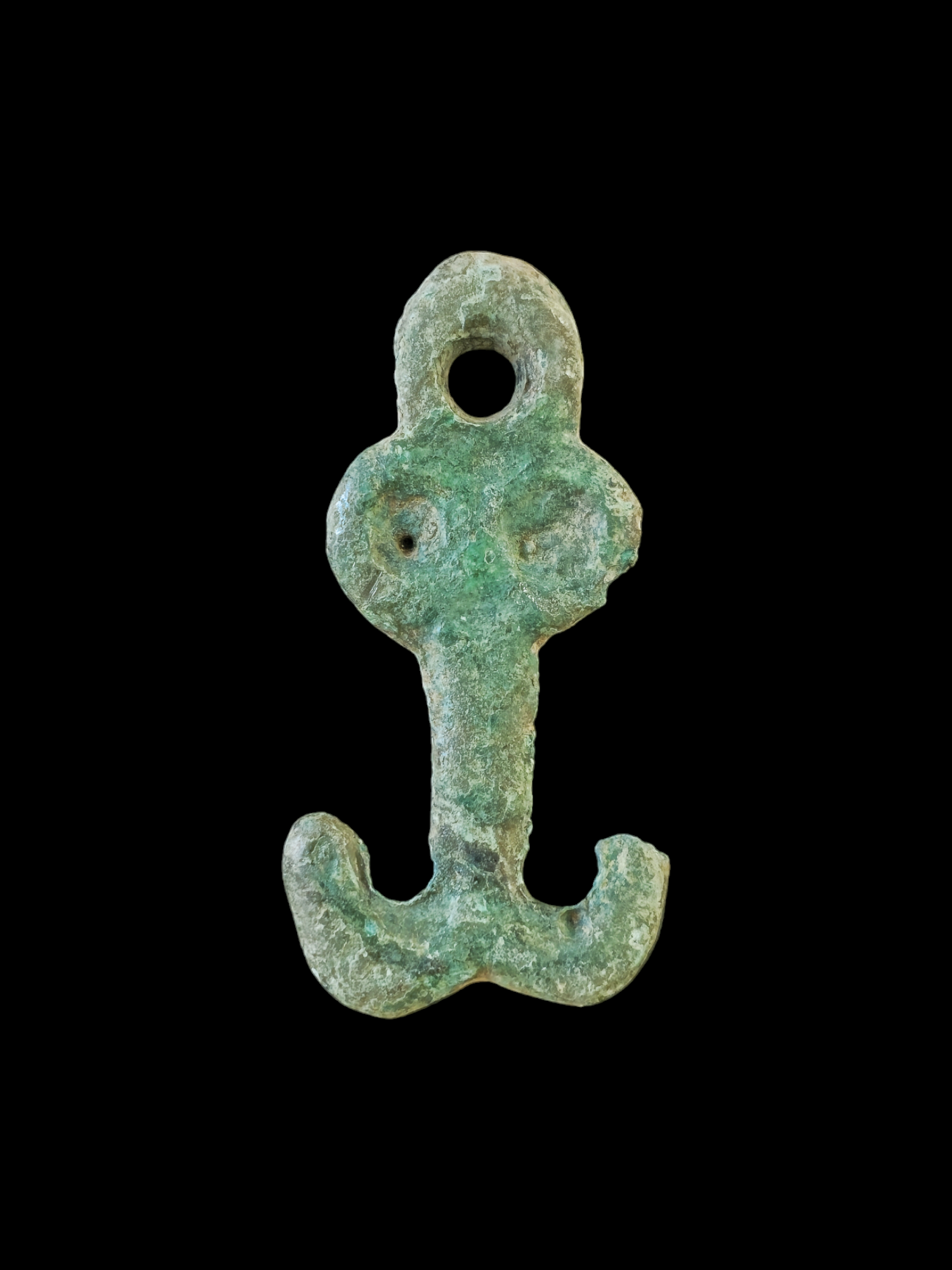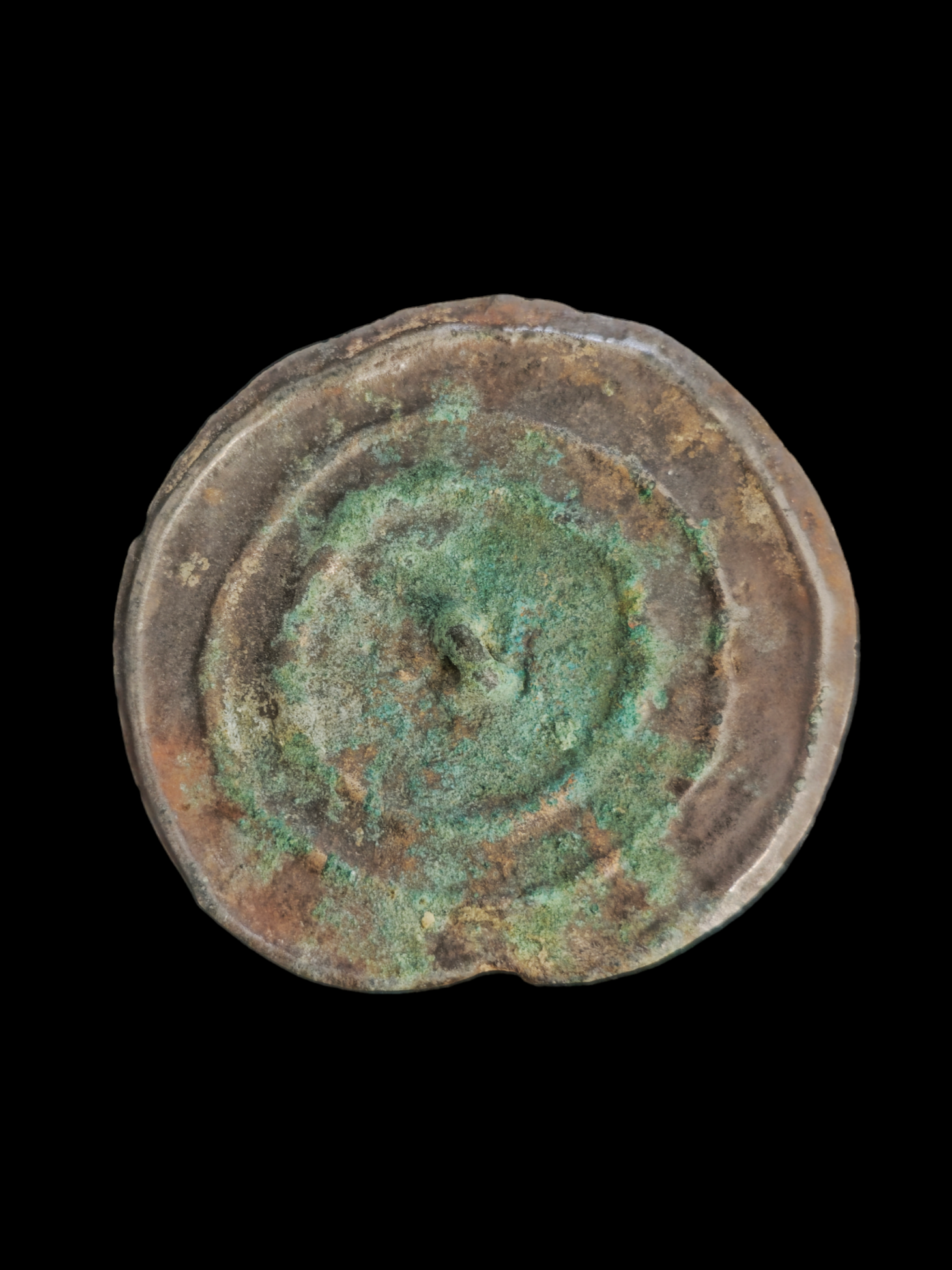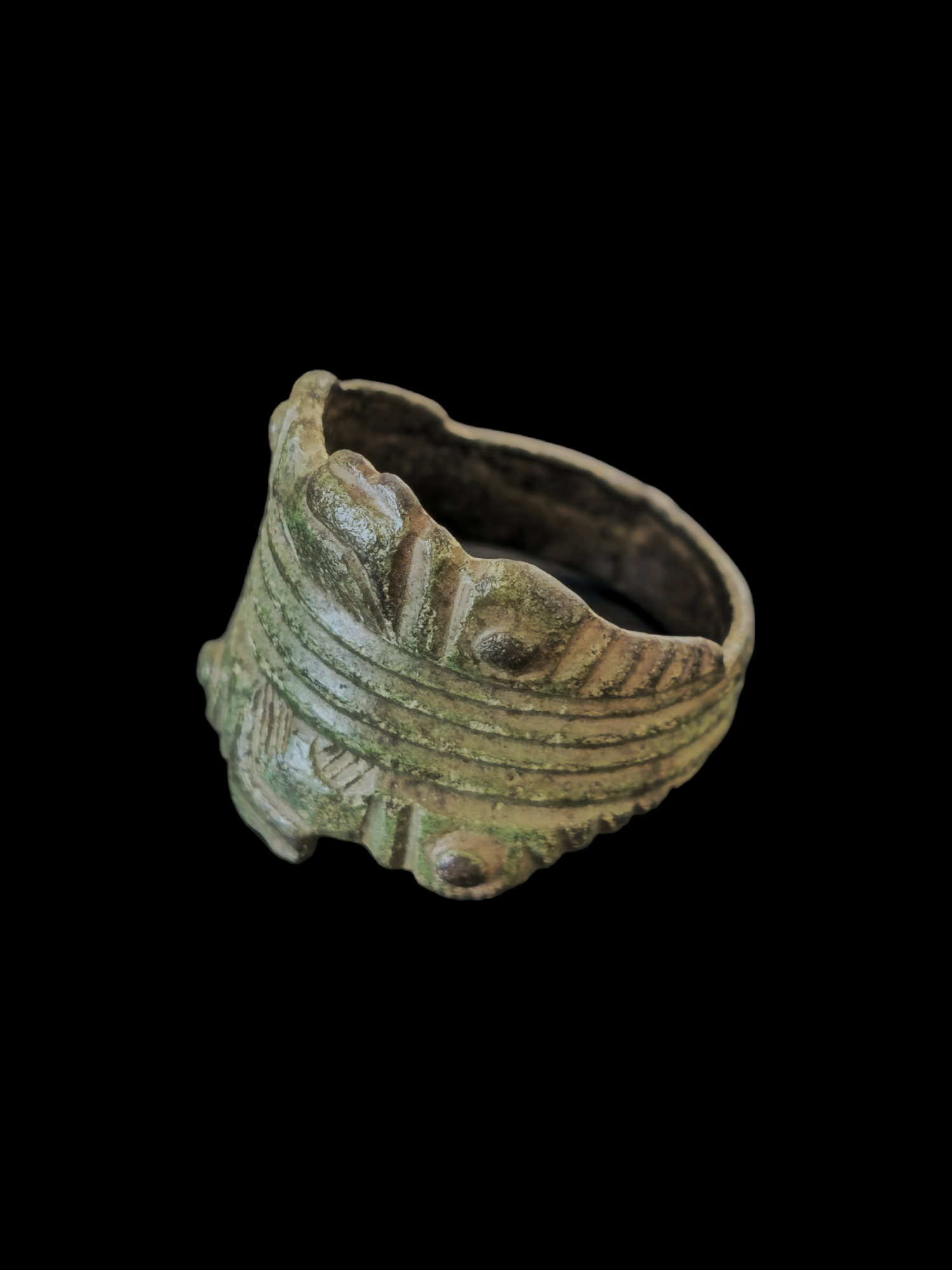
Among the most intimate objects to survive the Viking Age are those worn closest to the body — the small bronze amulets, fibulae, arm-rings, and pendants that Norse men and women carried through a world alive with unseen forces. To hold one of these pieces today is to touch a theology, a social contract, and an aesthetic tradition simultaneously compressed into a few grams of cast metal.
The Hammer and What It Meant
Mjölnir — Thor’s hammer — is the most recognisable symbol of the Viking world, yet its ubiquity as a pendant form belongs to a surprisingly narrow window of time. The characteristic T-shaped pendant, with its short haft and squared head, appears in quantity from the ninth century onwards, precisely when Scandinavian contact with Christian Europe was intensifying. The coincidence is not accidental. Thor was the protector of the common man: the farmer, the sailor, the smith. His hammer blessed marriages, consecrated graves, and drove off chaos. Wearing his emblem was both an act of piety and, increasingly, a declaration of identity at a moment when that identity was under pressure.
What makes Mjölnir pendants particularly compelling to the collector is their variety. They were produced across an enormous geographic range — from Iceland to the Dnieper — and in materials ranging from simple iron to elaborately decorated silver. Bronze examples are especially numerous, and their surfaces often carry ring-and-dot ornament, interlaced borders, or stylised faces that repay close examination. No two workshops produced quite the same form.
Arm-Rings and the Weight of a Promise
The arm-ring occupies a different register of meaning. Where the hammer amulet was devotional, the arm-ring was juridical. Oaths sworn upon a ring kept in the temple, or upon the ring-arm of a chieftain, carried a solemnity that the sagas record with consistent gravity. An oath breaker risked not merely social censure but supernatural retribution — the ring was, in some sense, a witness.
Arm-rings also functioned as portable currency. Viking-Age silver hoards routinely include rings that have been tested with a knife, weighed, and in some cases cut into fragments for immediate use. Bronze arm-rings, while less common in hoard contexts, appear frequently in grave assemblages and sometimes show surface wear consistent with long, habitual use. For the collector, the distinction between a display ring and a utilitarian hack-silver piece can be read in the metal itself — in the regularity of the surface, the crispness of any surviving ornament, and the ring’s cross-section.
“To hold one of these pieces today is to touch a theology, a social contract, and an aesthetic tradition simultaneously compressed into a few grams of cast metal.”
The Ambiguous Century: Hammer Meets Cross
The conversion of Scandinavia was neither sudden nor tidy. Christianity arrived incrementally, carried by merchants, missionaries, and ambitious kings who saw in the new faith a means of consolidating power. The result, across roughly the tenth and eleventh centuries, was a period of remarkable theological ambiguity — and the metalwork reflects it with startling literalness.
Among the most arresting discoveries in the archaeology of this period are the casting moulds that produce both Mjölnir pendants and Christian crosses from the same clay matrix. Found at several Scandinavian sites, these moulds speak to a craftsman serving a mixed clientele — or perhaps to converts who had not yet resolved what they believed. Syncretic amulets exist too: hammer-cross hybrids whose precise meaning remains contested, whether they represent a hedging of spiritual bets, a conscious synthesis, or simply the demands of fashion.
The fibulae of this era tell a similar story. Trefoil brooches of Carolingian inspiration sit in the same graves as purely Norse oval brooches. The iconographic vocabulary of beast ornament — Borre style, Jelling style, Ringerike style — continued to evolve independently of Christian imagery, yet it also absorbed it. An interlaced beast can carry Christian symbolism in one context and appear entirely secular in another. Reading these objects demands precisely the kind of sustained visual literacy that distinguishes an informed collection from an accidental one.
What the Collector Reads
When we advise collectors approaching Norse bronzes for the first time, we return consistently to a small set of questions. What is the form — amulet, brooch, ring, mount — and what was its likely function? What style vocabulary does the surface ornament deploy, and is it consistent with the proposed form and period? How does the patina behave across the surface, particularly in recessed areas where genuine age leaves signatures that are difficult to replicate? And finally: does the object carry a coherent identity, a sense that its elements belong together rather than having been assembled from convention?
Viking-Age personal objects are, at their best, extraordinarily coherent things. They were made by specialists who understood their symbolic weight, worn by people who believed in that weight, and deposited — in graves, in hoards, in rivers — with deliberate intent. The conversion era adds a further layer of interest, because it catches a culture in the act of negotiating with itself, working out in metal what it meant to be Norse in a world that was asking it to be something else. Few periods of material culture are more eloquent about the relationship between belief and identity. Fewer still have left us objects so portable, so affordable, and so intimately human.